What Nonprofits Can Learn From Enterprise-Wide Corporate Transformation (And What to Ignore)

Why execution discipline, change leadership, and operational rigor matter more than ever for mission-driven organizations.

As the new year begins, I’ve been reflecting on a pattern I continue to see across the organizations I work with—both in the private sector and in mission-driven nonprofits.

Before founding Red Hills Consulting Group, I spent years inside large, global organizations supporting and leading enterprise-wide transformation efforts. These were environments where change wasn’t theoretical or optional. It was complex, highly visible, and expected to deliver measurable results—often across regions, functions, and cultures.

Today, as I partner more deeply with nonprofits, foundations, and social-impact organizations, I see extraordinary commitment to mission and community. What I also see—far too often—is a gap between ambition and execution.

This isn’t a critique. It’s an observation grounded in lived experience on both sides.

The nonprofit sector does not need to become more corporate. But it does need to be more disciplined about execution, change leadership, and follow-through—especially as expectations for impact, accountability, and scale continue to rise.

Impact at scale requires more than heart. It requires systems that work.


What Actually Transfers From the Private Sector

Execution Is a Capability, Not a Phase

In corporate environments, strategy doesn’t end with a plan or a deck. That’s where the real work begins.

Across enterprise-wide transformations, I’ve supported organizations in different ways—first as a management consultant at Deloitte, PwC, and Capgemini, and later in corporate leadership and embedded advisory roles within global companies including Johnson & Johnson, Revlon, Publicis Groupe, and Pfizer. In each context, execution discipline was treated as a core organizational capability.

That discipline shows up as:

  • Clear ownership and decision rights
  • Realistic sequencing and resourcing
  • Milestones tied to outcomes—not activity

In many nonprofits, strategy is treated as the finish line rather than the starting point. The result is familiar: strong plans that quietly stall under the weight of day-to-day operations.

A strategy without execution infrastructure is just aspiration.


Change Management Is Strategic, Not “Soft”

In the private sector, change management was never an afterthought. It was a funded, staffed workstream with clear accountability.

That experience taught me something I carry into every nonprofit engagement:

Resistance isn’t dysfunction. It’s data.

Yet in many mission-driven organizations, change is still underestimated:

  • Communications are reactive
  • Stakeholder engagement is compressed
  • Adoption is assumed rather than designed

When teams are fatigued or skeptical, leaders are often surprised—despite having asked people to absorb multiple shifts without the time, clarity, or support to do so well.

Change doesn’t fail because people are difficult.
It fails because leaders don’t invest in helping people cross the bridge from old ways of working to new ones.


Data Discipline Protects the Mission

Corporate environments taught me how to use data without losing the human center.

Not vanity metrics. Not dashboards for their own sake. But:

  • Leading indicators that surface risk early
  • Measures tied directly to strategic priorities
  • The discipline to course-correct in real time

In nonprofits, data discipline isn’t about corporatization. It’s about stewardship. When resources are scarce and the stakes are high, clarity matters.

Rigor doesn’t replace values. It protects them.


Where AI Is Raising the Stakes

This gap between ambition and execution has become even more visible as nonprofits rush to explore AI and other digital tools.

AI doesn’t fix broken processes, unclear ownership, or change fatigue. It amplifies them.

Organizations without strong operational foundations don’t become more effective with AI—they become more overwhelmed. Tools move faster than people can adapt, and leadership struggles to keep pace.

The nonprofits most likely to benefit from AI are not the most tech-forward. They are the most operationally prepared.

AI, like any enterprise-wide transformation lever, raises the bar for execution discipline. It rewards clarity and exposes gaps.


What Nonprofits Should Be Careful Not to Borrow

Over-Engineered Frameworks

Some corporate tools are designed for scale, compliance, and uniformity—not agility.

Nonprofits don’t need bloated governance models or overly complex processes. They need fit-for-purpose systems that reflect their size, culture, and mission.

The lesson isn’t to copy templates.
It’s to apply principles.


Top-Down, People-Blind Transformation

Command-and-control approaches may move quickly in some corporate environments. They rarely work in mission-driven ones.

Nonprofits rely on trust, community, and shared purpose. Ignoring staff voice or community context in the name of speed undermines the very outcomes leaders are trying to achieve.

Faster isn’t better if it fractures trust.


The Cost of Ignoring Enterprise-Scale Experience

Here’s the pattern I see repeatedly when execution expertise is deprioritized:

  • Strategy refreshes every 18–24 months
  • Initiatives that never fully land
  • Burned-out teams carrying invisible operational load
  • Boards frustrated by “lack of progress” without clarity on why

When organizations avoid hiring or partnering with leaders who have managed complexity at scale, inefficiency becomes normalized—and impact quietly plateaus.

This isn’t about pedigree.
It’s about pattern recognition.

Enterprise-wide transformation teaches you how systems break, how people respond to change, and where execution most often fails. Those lessons are deeply transferable—when translated thoughtfully.


The Hybrid Leader Nonprofits Actually Need

I don’t bring corporate thinking into nonprofits.

I translate what works—and intentionally leave the rest behind.

That hybrid approach draws on:

  • Corporate execution rigor
  • Nonprofit empathy and mission alignment
  • Global and cross-sector perspective
  • Deep change-leadership experience

It’s not either/or. It’s discernment.

The nonprofits that will thrive in the coming decade won’t reject corporate approaches wholesale—or adopt them blindly. They’ll invest in leaders and partners who know how to bridge strategy and execution, values and systems, ambition and reality.

Because impact at scale requires more than heart.

It requires systems that work.

About Renée
Renée Jones is the Founder and CEO at Red Hills Consulting Group, where she leads strategic, operational, and transformational initiatives for Fortune 500 companies, nonprofits, and mission-driven organizations. With more than 20 years of experience leading complex initiatives, Renée helps organizations turn bold ideas into lasting impact. Outside of work, she mentors emerging leaders and champions social-impact innovation. 

🌍 Southern Africa Changed Me: Adventure, Reality & What Zimbabwe Taught Me About Opportunity and Equity

I’ve traveled all over the world, but my recent journey through Zimbabwe, Zambia, and Botswana hit differently. It was breathtaking, humbling, hilarious in moments, terrifying in others (yes, I fell off a horse), and ultimately transformative in ways I’m still unpacking.

This trip awakened both sides of me:

  • Renée the traveler, rooted in Caribbean heritage and deeply connected to the African diaspora…
  • and Renée the founder of Red Hills Consulting, forever thinking about equity, opportunity, systems, and the people whose lives are shaped by them.

Southern Africa gave me beauty and adventure.
But it also handed me truths that global leaders, policymakers, and mission-driven organizations cannot afford to ignore.

But before we get to the lessons — let’s talk about the adventure.
Because this trip was epic.


🔥 Adventure Highlights (In No Particular Order Because My Trip Was Chaos Meets Magic)

Traveling through Southern Africa handed me every emotion on the spectrum — awe, humility, fear, joy, wonder, laughter, and plenty of “this would only happen to me” moments.

These are just a few of the many unforgettable highlights:


🏨 A Warm Zimbabwe Welcome at Insika Lodge

Our home base in Zimbabwe was Insika Lodge, a serene, intimate retreat that set the perfect tone for the journey. Cozy, beautiful, rooted in the landscape, and run by people whose hospitality made the experience feel deeply personal.

Small group.
Private guides.
A slow, intentional pace.
It felt like we were exactly where we were meant to be.


🐎 The Horseback Safari Plot Twist

Ah yes… the infamous fall.

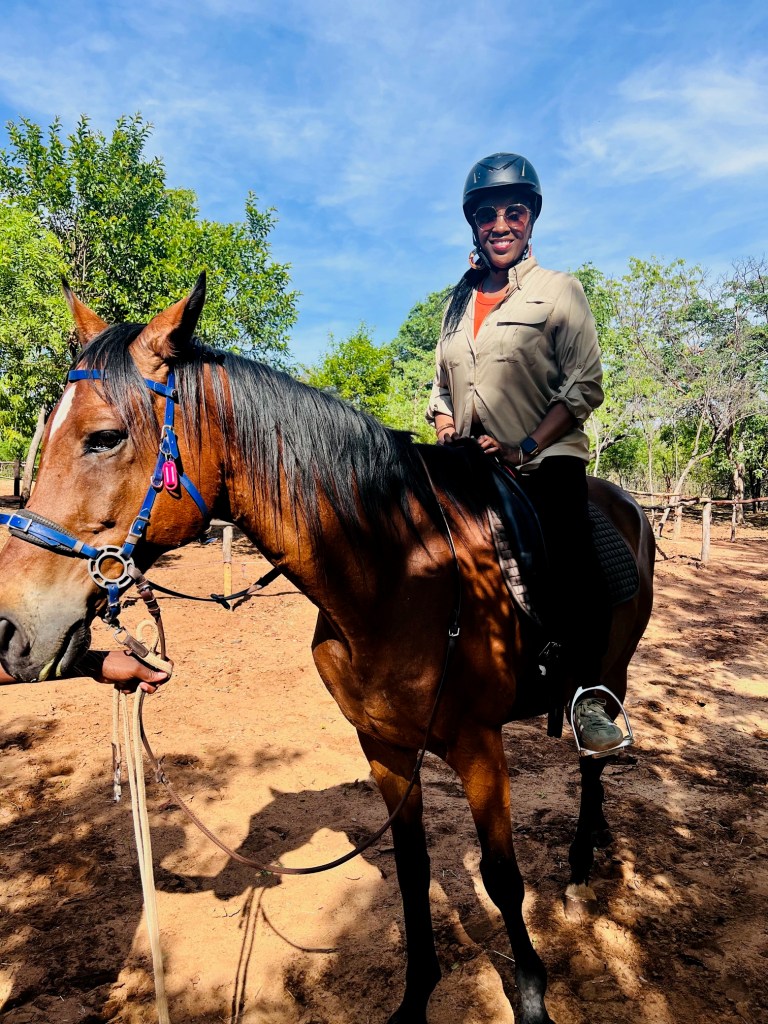
My horse was already antsy. Hyenas were nearby. I politely suggested we not stop. Life said, “Girl, please.”

He bucked.
I flew.
Gravity did its job.

I walked away with bruises, gratitude, and a whole new respect for horses with attitude. Thankfully, my guide arranged a 90-minute full body massage back at the lodge — the kind of healing I didn’t know I needed until every muscle started talking. And for that, I was deeply grateful.


🌅 Peace on the Zambezi

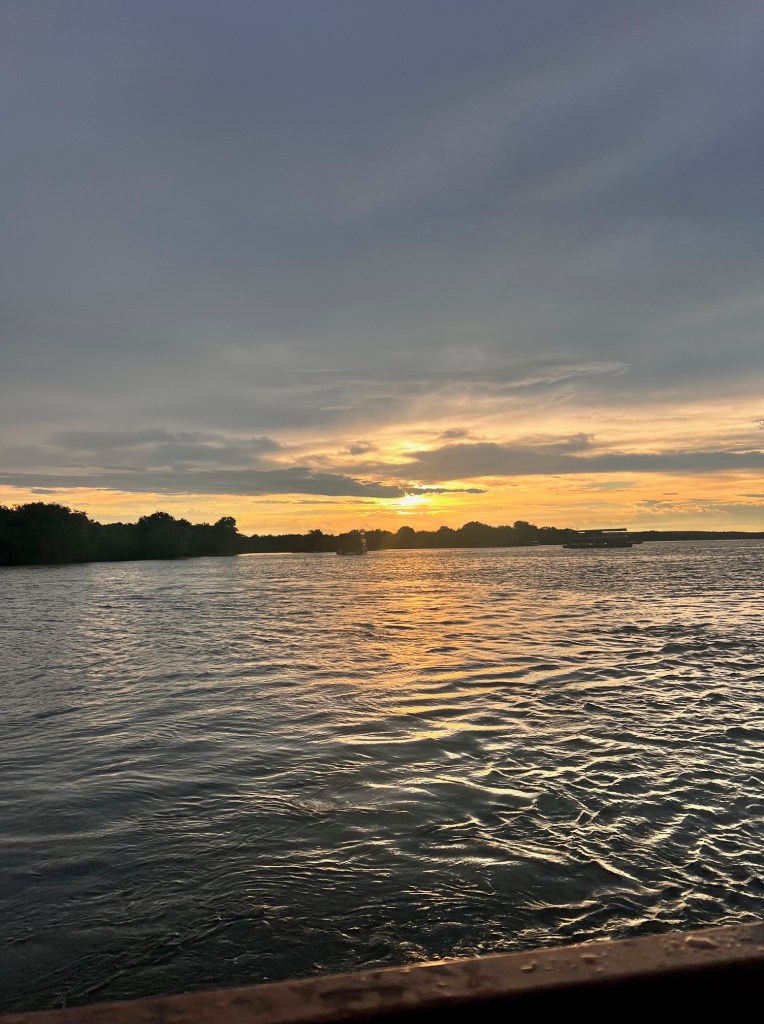
A few hours later, I found healing on a peaceful dinner cruise along the Zambezi River.
The contrast was poetic.

Elephants wading.
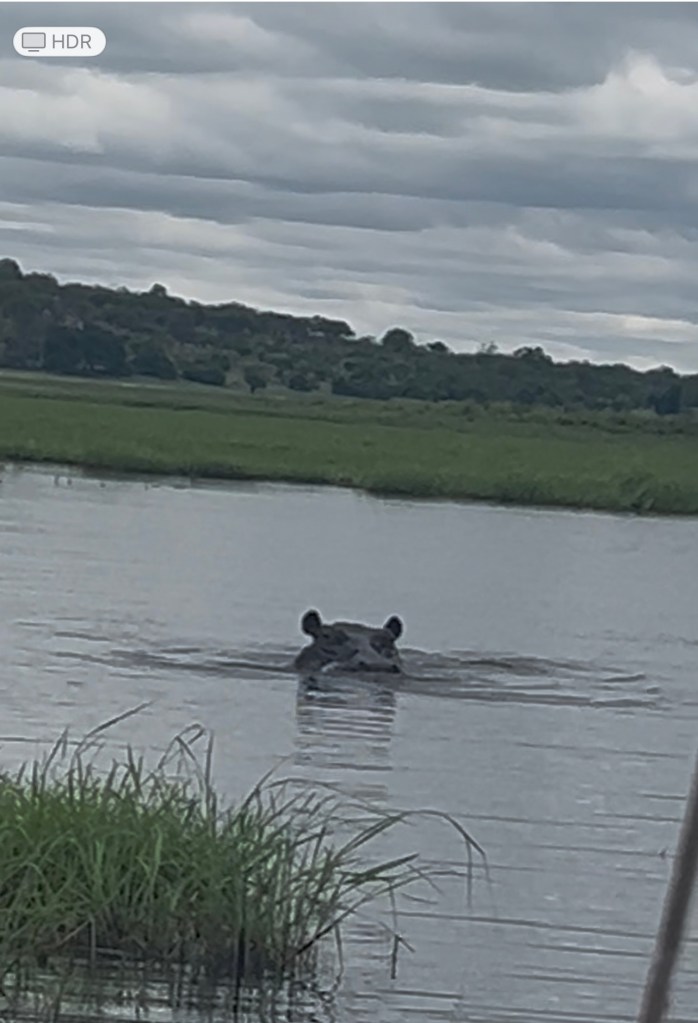
Hippos bobbing in and out of the water.
A sunset so gorgeous the sky felt suspended in prayer.

It turned a chaotic morning into a restorative night.


🍽 Dinner at Chef Vee’s Home

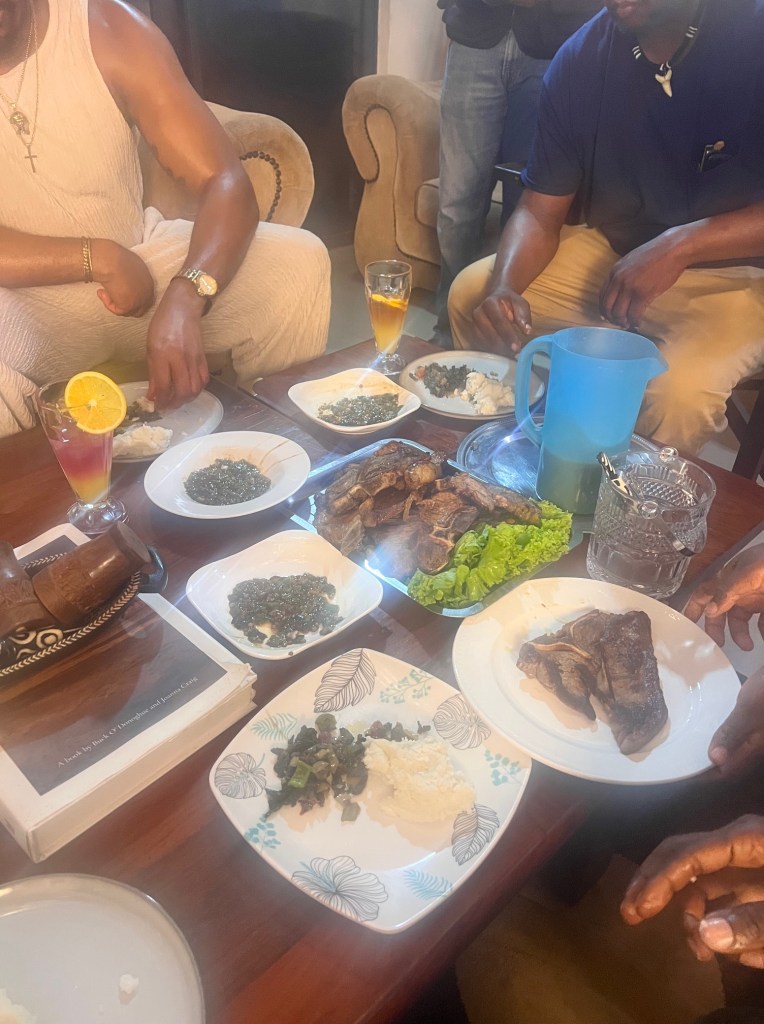
One of the most intimate moments of the trip was being welcomed into Chef Vee’s home to cook and enjoy a traditional Zimbabwean meal.

It wasn’t a performance.
It was community.
It was culture.
It was connection.

We chopped, stirred, laughed, learned, and shared stories around the table — including me proudly preparing a delicious salad for the group… that we completely forgot to take out of the fridge. We remembered it way too late, but honestly? We were so focused on the meal, the conversation, and the moment that none of us missed it until the laughs came after.

A true highlight — salad or no salad. 😄


💦 Devil’s Pool — Living Life on the Very Edge

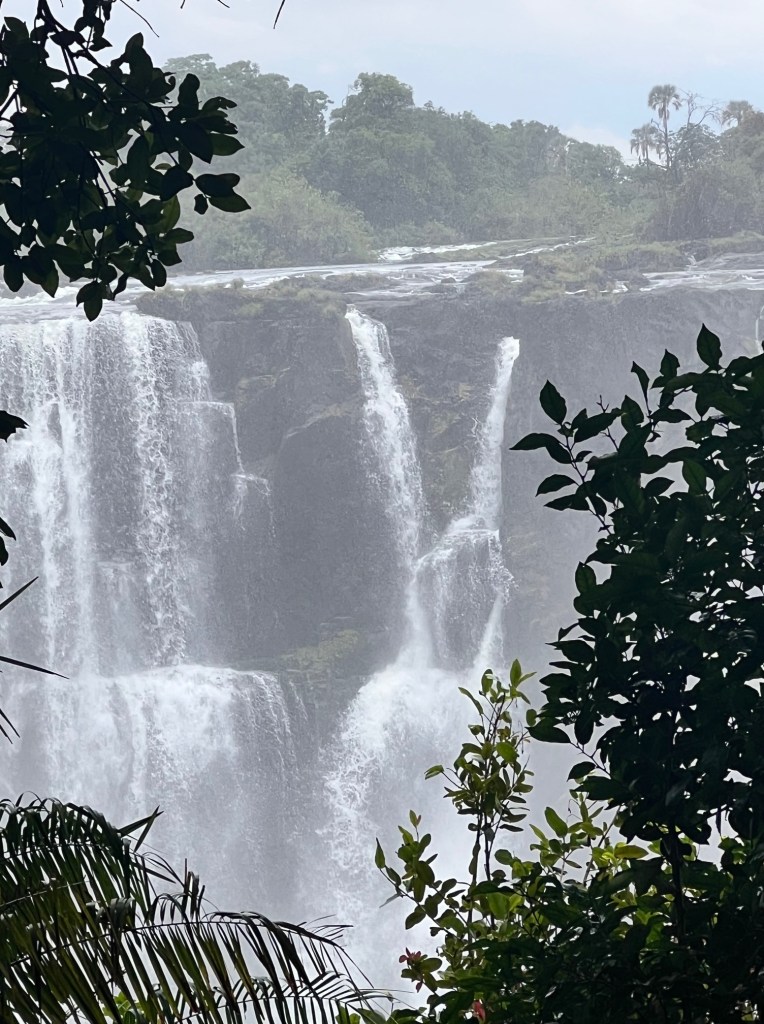
Imagine floating at the literal edge of Victoria Falls, holding onto rocks that separate you from one of the world’s largest waterfalls.

That’s Devil’s Pool.

Equal parts terror and adrenaline.
The kind of experience that makes you question your choices and then thank yourself for making them anyway.


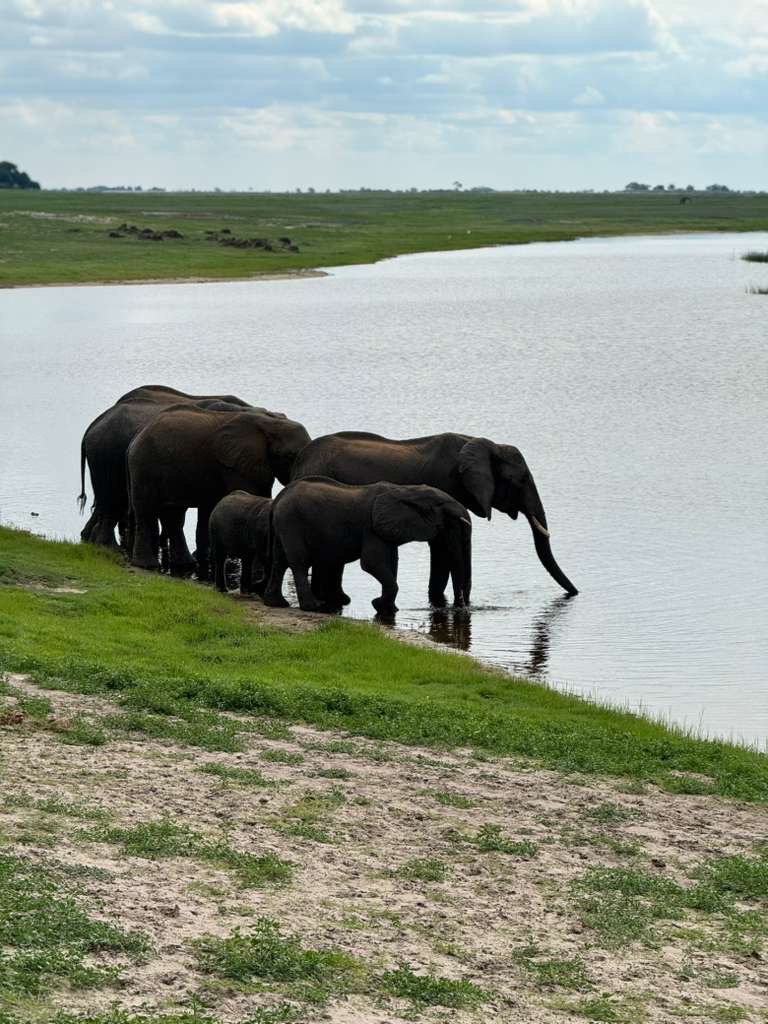
🌍 Victoria Falls & Chobe National Park

Victoria Falls humbled me with its force and beauty.
Chobe stunned me with its abundance — elephants everywhere, lions, and giraffes casually strolling by, nature showing off effortlessly.

Every moment felt sacred.


🦛 The Hippo Encounter at Chobe

Chobe delivered more than breathtaking views — it delivered surprises.
During our water safari, a hippo suddenly charged toward our boat, and we sped away fast.

A wild, unforgettable moment — and yes, it’s all on video.


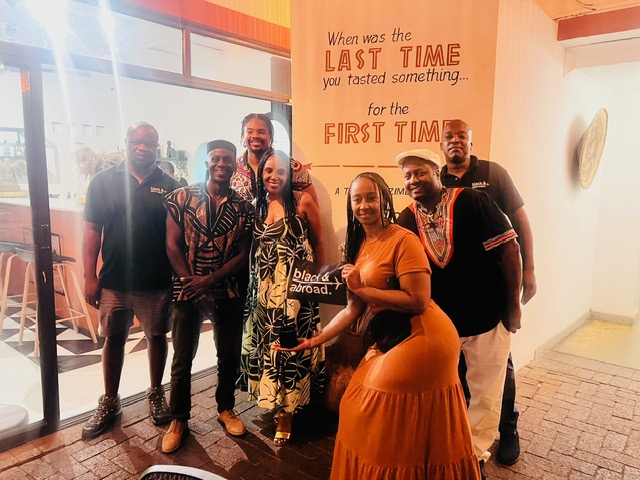
🛫 Traveling with Black & Abroad

We were among the very first small groups to experience this new tri-country itinerary with Black & Abroad — Zimbabwe, Zambia, Botswana.

And it was exactly my style:

  • intentional
  • intimate
  • culturally rooted
  • flexible
  • community-focused

I’ve traveled with Black & Abroad before — to Tanzania and Zanzibar a couple of years ago — and that journey was equally transformational. There’s something powerful about exploring the continent through a lens that honors history, culture, and the diaspora.

A huge shout-out to our guide, Habeeb, and our driver, Anthony — the real MVPs of this journey. Their care, knowledge, humor, and attention to detail took this experience from memorable to unforgettable. They made us feel safe, supported, and fully immersed every step of the way. Absolute rockstars.

With this recent journey, I’ve now traveled to nine African countries — and every single time, the continent shifts something in me in ways I can’t fully put into words. And the count won’t stop here; there are several more on my list.


💛 The Emotional Undercurrent: A Journey Rooted in Healing & Heritage

Before boarding my flight, I wrote about how the last time I was on the continent — in Rwanda — I received news of my father’s passing. That moment forever tied Africa to grief, love, and transformation for me.

This time, I returned with peace, openness, and my father’s memory tucked beside me.
The sunsets felt spiritual.
The land felt welcoming.
The journey felt necessary.

With my extended family in Jamaica recovering from Hurricane Melissa, I carried them with me too — their resilience, their strength, their hope.

This trip reminded me how interconnected we all are across the diaspora.


💔 The Reality Beneath the Adventure: Zimbabwe’s Untold Truth

Beyond the beauty and hospitality, Zimbabwe revealed something deeper — not through formal interviews or chance encounters, but through the stories shared by our personal driver and local guides who spoke candidly about the realities their families, friends, and communities face every day.

Zimbabwe is full of brilliant, educated, capable people who cannot find work.

Teachers.
Engineers.
Business graduates.
Doctors.

People who earned degrees, built skills, and did everything society told them to do — yet still find themselves with no stable path to opportunity.

Many cross the border into Zambia or Botswana for temporary or informal work, and some even make the longer journey to South Africa in search of more stable opportunities.
Others, equally skilled, survive by selling fruit, crafts, or souvenirs to tourists — not because it’s their calling, but because survival demands it.

And while Zimbabwe’s situation is unique in many ways, this reality is not — many developing nations face similar patterns of underemployment, economic strain, and talent forced into survival-mode work.

It is heartbreaking.
It is systemic.
And it is not a reflection of their ambition — it is a reflection of the economic environment they’re navigating.


📉 Tourism Helps… But Currency Instability Hurts

Zimbabwe should be a tourism powerhouse.
And in many ways, it is — the attractions are world-class.

But here’s the economic reality:

1. Tourism dollars leak out of the system.

Because of currency instability:

  • USD is hoarded
  • inflation wipes out value
  • reinvestment is limited
  • wage gains evaporate quickly

It’s hard for communities to get ahead when the economic ground is constantly shifting.

2. Tourism becomes relief — not transformation.

Without broader policy and currency reforms, tourism can’t create the long-term, equitable growth it should.


Then I Returned Home… and Saw Familiar Patterns

Coming back to the U.S., I couldn’t ignore the parallels:

  • DEI rollbacks
  • layoffs hitting marginalized groups
  • shrinking economic mobility
  • talented people doing everything “right” yet struggling to advance

Different continent.
Different systems.
But the same underlying truth:

When opportunity collapses, inequity grows — everywhere.

Harare. Harlem. Lusaka. Los Angeles.
The patterns are interconnected.


🔴 What This Journey Reaffirmed for Red Hills Consulting Group

This trip reinforced why Red Hills exists.

1. Transformation must be human-centered.

Strategy without humanity is ineffective.

2. Equity is global. And fragile.

Without intention, systems exclude.

3. Economic mobility changes everything.

Where opportunity expands, communities thrive.

4. Our work matters — more than ever.

We partner with organizations committed to:

  • empowering marginalized communities
  • creating equitable pathways
  • centering people in strategy
  • building systems of opportunity

This trip sharpened that purpose.


💬 Final Reflection: The Motherland, My Mission & What Comes Next

Southern Africa gave me joy, healing, courage, perspective, and clarity.
It reminded me of the beauty of our diaspora and the urgency of our work.

Talent is universal.
Opportunity is not.
And until it is, Red Hills will keep pushing.

Here’s to honoring our roots.
Here’s to global connection.
Here’s to doing good work — wherever the journey takes us next.

About Renée
Renée Jones is the Founder and Principal Consultant at Red Hills Consulting Group, where she leads strategic, operational, and transformational initiatives for Fortune 500 companies, nonprofits, and mission-driven organizations. With more than 20 years of experience leading complex initiatives, Renée helps organizations turn bold ideas into lasting impact. Outside of work, she mentors emerging leaders and champions social-impact innovation. https://redhillsconsultinggroup.com

The Value Question: Why Do Organizations Overlook Operational Excellence?

Growth starts inside. Too many leaders overlook this truth—and it’s costing them.

Lately, I’ve been asking myself a hard question: why do so many organizations hesitate to invest in the very services that could help them grow and thrive?

As the Founder of Red Hills Consulting Group, I’ve seen leaders nod along when we talk about operational excellence, strategy alignment, and transformation—but too often, those conversations stall before they turn into action. It’s not because the ideas lack merit. More often, it’s because leaders don’t fully see the value—or feel unable to prioritize it.

So what’s really going on?


The Challenge Behind the Hesitation

Funding realities. Mission-driven organizations and nonprofits, in particular, are facing difficult headwinds. Federal budgets are being cut, philanthropy is shifting, and donor fatigue is real. Every dollar feels stretched, and investments in operations or change management often take a back seat to program delivery.

Short-term vs long-term tension. Leaders are under pressure to show immediate results. External wins—new programs launched, partnerships announced, fundraising milestones—often get prioritized over internal strengthening. It’s understandable, but it comes at a cost.

Perception gap. Too many leaders still see operational excellence, streamlined processes, or change management as “nice to have” initiatives rather than the very foundation of growth and sustainability. They underestimate the silent drag of inefficiency, misalignment, and poor communication.

Change fatigue. After years of disruption—the pandemic, workforce churn, political uncertainty, and DEI rollbacks—many organizations are exhausted by the idea of “more change.” Even when they know improvements are needed, leaders may avoid starting because the lift feels heavy.


The Missed Opportunity

What’s often overlooked is that broken systems, unclear processes, and siloed teams quietly bleed organizations of time, money, and morale.

Every week wasted in inefficient meetings, every dollar lost to duplication, every hour spent reinventing the wheel instead of advancing the mission is a cost. And it’s a cost that compounds.

You can’t deliver on your mission externally if your house is crumbling internally. Long-term growth and impact demand a strong foundation. The external wins that boards, donors, or shareholders want to see start with fixing what’s beneath the surface.


The Red Hills Approach

At Red Hills Consulting Group, we help organizations move from vision to value. That means more than solving problems—it means creating capacity, clarity, and measurable impact.

We do this by:

  • Clarifying Direction
    Helping leaders define a vision and roadmap so priorities are aligned.
  • Aligning People + Processes
    Building structures, culture, and operations that support transformation and scale.
  • Optimizing Performance
    Driving efficiency, transparency, and accountability with proven methodologies.
  • Navigating Change
    Guiding adoption and engagement so transformation sticks.
  • Amplifying Social Impact
    Strengthening nonprofit and CSR strategies so organizations deliver measurable change.

This is not about adding complexity. It’s about reducing noise, removing barriers, and unlocking the capacity organizations already have to achieve their boldest goals.


A Question for Leaders

So here’s the question I’d invite leaders to reflect on:

👉 What would it mean for your organization if you invested in fixing the internal challenges that slow you down?

Would your teams have more capacity to innovate? Would your stakeholders trust you more? Would you finally see the external growth you’ve been chasing?

The organizations that recognize operational excellence as a growth accelerator—not an expense—are the ones that will not just survive in this climate, but thrive.


Closing

At Red Hills, this is the work we love most: guiding organizations through the transformation that allows them to scale impact, amplify purpose, and build sustainable growth.

The value is there—sometimes it just takes a mindset shift to see it.

If your organization is ready to explore that shift, we are here to help.

About Renée
Renée Jones is the Founder and Principal Consultant at Red Hills Consulting Group, where she leads strategic, operational, and transformational initiatives for Fortune 500 companies, nonprofits, and mission-driven organizations. With more than 20 years of experience leading complex initiatives, Renée helps organizations turn bold ideas into lasting impact. Outside of work, she mentors emerging leaders and champions social-impact innovation. 
Breaking Barriers, Building Bridges: My Journey to Red Hills Consulting Group

Renée Jones, Founder of Red Hills Consulting Group

In a high-rise conference room, I realized that despite my seat at the table, my voice still felt unheard. That moment changed the trajectory of my career…

My career has taken me from Fortune 50 boardrooms to supporting grassroots nonprofits in rural East Africa. Along the way, I’ve navigated corporate cultures, led high-stakes transformation projects, and built a consulting practice grounded in equity, purpose, and measurable impact. This is the story of how lived experience — as a Black woman in predominantly white spaces, as a strategist, and as a changemaker — shaped my vision for Red Hills Consulting Group.

Early Foundations

Where my foundation in business — and purpose — began.
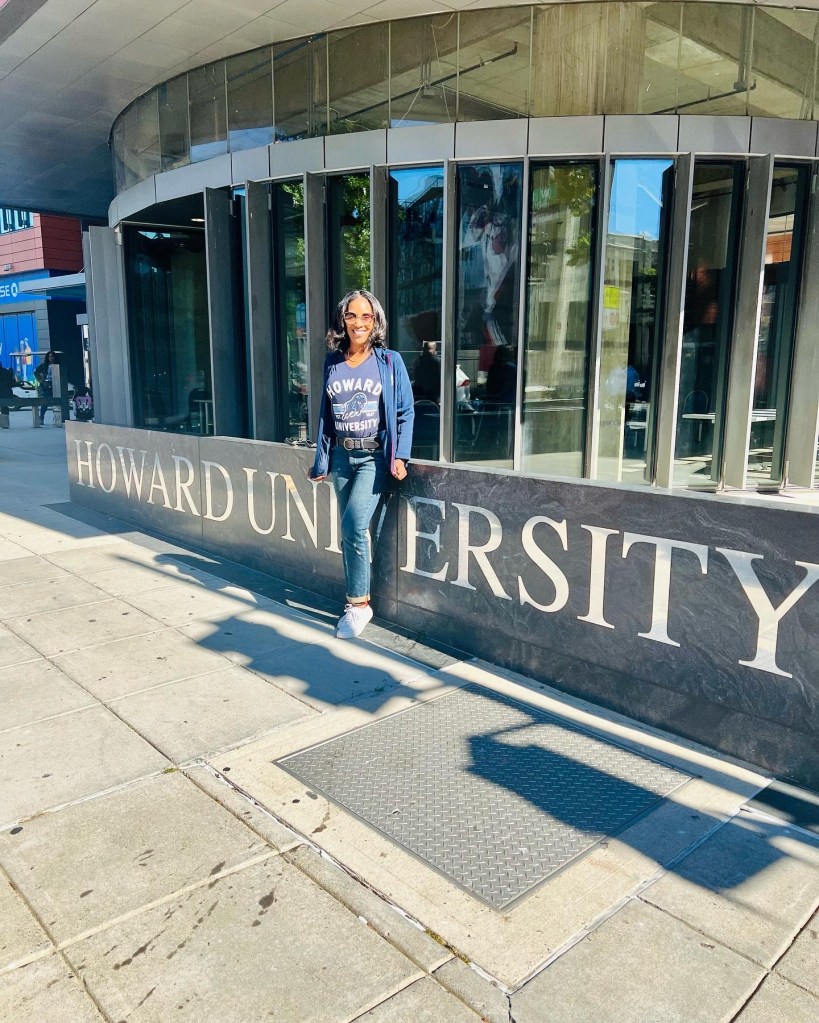
From Howard University’s campus to Fortune 50 leadership roles, the journey started here.

At Howard University, I pursued a degree in Accounting because it seemed like the practical thing to do. In my Caribbean family, business degrees were a respected path — stable, honorable, and certain to lead to employment right out of school. As the daughter of Jamaican immigrants, I wanted to make my family proud and follow a path that was proven.

I envisioned myself earning a CPA and joining an accounting firm for a long, steady career. But the reality was different — while I gained valuable, hands-on experience at an accounting firm, I quickly realized I didn’t love the work. I wasn’t energized by the exam prep or the prospect of spending my career focused solely on accounting details. My heart was elsewhere, even if I didn’t yet know where “elsewhere” was.

Shifting Toward Strategy

So, I pivoted — moving into other roles in accounting and finance before deciding to return to school for my MBA. That decision changed everything. It opened doors to financial planning and analysis roles, where I could connect numbers to strategy and make decisions that moved the business forward.

One of the most pivotal career moments came at the National Black MBA Association conference, where I was recruited by Johnson & Johnson through their MBA diversity hiring program. The opportunity required me to relocate from Maryland to New Jersey — a leap that brought me into the world of a Fortune 50 company. At J&J, I took on a Senior Financial Analyst role in Marketing Finance, supporting the company’s largest pharmaceutical operating company — a $7.7B business. My work spanned strategic planning, forecasting, and business case development, including financial analysis for the anticipated launch of a product projected to reach $650M in peak sales. Beyond sharpening my finance expertise, I learned to navigate the complexities of a large, global organization. More importantly, I saw firsthand how numbers could drive business strategy and market impact — a turning point in how I approached my career. That experience not only broadened my professional horizons but also affirmed that being intentional about opportunities could lead to game-changing outcomes.

Navigating Corporate Consulting

Bringing clarity to complex challenges through innovation and insight.
Like fitting the right puzzle piece, transformation requires precision and vision.

But as I climbed the corporate ladder, I also faced challenges that many Black women in predominantly white corporate spaces know well — the lack of mentors and sponsors, being passed over for promotions despite stronger qualifications, and navigating microaggressions while maintaining professionalism.

That became even more evident when I entered the world of management consulting, where success required not just expertise, but also access to the right networks and unspoken circles. As a Black woman, breaking into those spaces took more than skill — it demanded persistence, adaptability, and strategic relationship-building.

It was this blend of technical expertise and intentional relationship-building that defined some of my most meaningful consulting engagements — including one that stands out vividly.

One engagement that crystallized my consulting philosophy was a rapid, three-week turnaround for a global luxury brand’s Finance function. Inefficiencies were slowing decisions and obscuring performance insights, and time was critical. In less than a month, I worked closely with leaders to uncover the root causes, cut through bottlenecks, and deliver targeted recommendations that could be put into action immediately. The result: leaner processes, sharper reporting, and a shift toward best practices — all without disrupting daily operations. It reinforced a core belief I carry into every project: the right insights, at the right moment, can spark transformation without delay.

I worked primarily across Strategy & Operations, Transformation, and the CFO Advisory practice. I learned from brilliant minds and global organizations, traveled extensively, and built a consulting skill set that would serve me for the rest of my career. The perks were real — the airline miles, the hotel points — but so were the pressures. The culture could be competitive and, at times, isolating. Eventually, I began to feel something was missing: I needed more purpose, more meaning, more passion in my work.

A Seed Is Planted

Planting seeds for growth — in organizations and communities.
Change takes root when the right conditions — and the right partners — are in place.

That search for meaning led me to volunteer with Taproot Foundation more than a decade ago. I was inspired by their mission to connect skilled professionals with nonprofits and small businesses, helping them solve complex challenges. It was my first taste of applying my expertise in a purely mission-driven way — and it planted a seed that would shape the future of my career.

The Leap to Independence

A few years later, after the long hours, constant travel, and limited promotional opportunities had taken their toll. I was ready for a change — and the timing was right. I was tapped by an organization that deploys on-demand talent for their most important client projects. The role offered the chance to work independently while applying everything I’d learned at major companies. It was the right opportunity at the right moment, and I felt prepared for it.

That’s when I created Red Hills Consulting Group — initially as a business entity for independent engagements — and began leading and supporting enterprise-wide business transformation programs across Fortune 500 companies and nonprofits. I named it Red Hills Consulting Group — inspired by my Jamaican roots and my vision of blending strategic clarity, operational excellence, and social impact. At the time, I saw it as a business vehicle, not yet a calling.

Around this time, I also earned my Project Management Professional (PMP) certification — a deliberate step to deepen my expertise, strengthen client confidence, and ensure my practice met the highest standards of delivery.

Aligning Work with Values

Shifting from corporate success to mission-driven impact — aligning strategy with values to create lasting change.

I continued to build my resume in corporate and consulting roles. However, when a major client unexpectedly ended my contract despite strong performance and awards, it reinforced the importance of keeping my consulting practice active. I quickly secured new engagements, but I also recognized that I wanted my work to be better aligned with my values.

That realization became undeniable after a senior leadership role at a large multinational corporation brought more of the same challenges I had seen before. When that role ended, it was difficult in the moment — but ultimately one of the best things that could have happened to me.

I took time to reset, reflect, and get intentional. I knew I wanted to work with mission-driven organizations committed to social impact, corporate social responsibility, and advancing equity, access, and opportunity. I wanted my work to empower women, people of color, and communities that had been overlooked. And I wanted to build something on my own terms.

Turning Point: Mission-Driven Focus

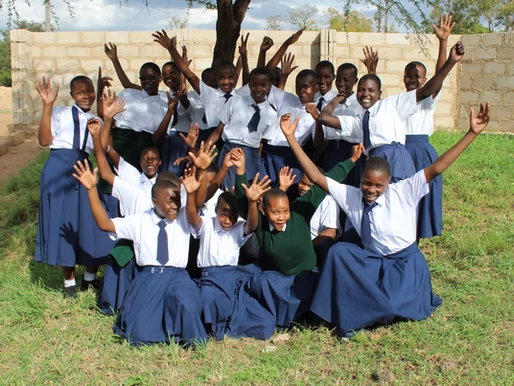
Empowering the next generation through access to education.
At Tanzania Development Support, strategy meets life-changing results.

Across my career — from Fortune 500 companies to philanthropic organizations — I’ve helped leaders drive transformation, operational excellence, and measurable results. Yet, even as I thrived in corporate and cross-sector work, something was still missing — a deeper sense of purpose.

That shift came into focus after a transformational journey to Tanzania and Zanzibar Island — an experience that broadened my worldview and brought clarity to my purpose. The timing was serendipitous: soon after returning, I had the opportunity to support Tanzania Development Support (TDS) through another Taproot service grant, helping to craft a fundraising strategy that would fuel their mission. In 2023, I joined the TDS Board of Directors, where I now lead the Evaluation Committee, assessing and measuring progress toward expanding educational access in rural East Africa. Doing this work — seeing the direct link between strategy, resources, and life-changing outcomes — has been transformative. It confirmed that mission-driven consulting isn’t just my passion; it’s where I can create the most meaningful impact.

The Red Hills Vision

Connecting vision to execution, and people to possibilities.
The bridges we build today will carry the next generation forward.

That’s when Red Hills Consulting Group moved from the background to the forefront. I shifted my energy toward growing the firm, while still applying for selective roles that aligned with my mission. In June 2025, I launched the Red Hills website — a visible commitment to this next chapter.

Today, Red Hills partners with mission-driven nonprofits, philanthropic organizations, and forward-thinking corporations. Our work bridges the gap between vision and execution — helping organizations achieve operational excellence without losing sight of their values.

The real fulfillment for me now comes in building bridges:

  • Equipping nonprofits to scale their programs without losing their soul
  • Guiding corporate teams to embed equity into transformation efforts
  • Creating partnerships that connect resources to the communities that need them most

Looking ahead, my vision is clear: to grow Red Hills into a trusted ally for organizations doing the hard, necessary work of creating a more equitable world. My journey has taught me that breaking barriers is only part of the work — the real fulfillment comes in building bridges strong enough for many to cross, sturdy enough to last. Bridges for the next leader, the next woman of color, the next mission-driven organization, so they can go even further.

How has your lived experience shaped your career path?

Follow me at www.redhillsconsultinggroup.com for ongoing insights.

About Renée
Renée Jones is the Founder and Principal Consultant at Red Hills Consulting Group, where she leads strategic, operational, and transformational initiatives for Fortune 500 companies, nonprofits, and mission-driven organizations. With more than 20 years of experience leading complex initiatives, Renée helps organizations turn bold ideas into lasting impact. Outside of work, she mentors emerging leaders and champions social-impact innovation. 

Equity Meets Innovation: Responsible AI for Social Impact

Responsible AI starts with people, purpose, and values.

As a strategist and transformation leader with more than 20 years of experience across the private and nonprofit sectors, I’ve witnessed firsthand the power of well-deployed systems—and the consequences of ignoring their social implications.

I don’t come to this topic as a technologist or AI researcher. I come to it as a strategist, a nonprofit advisor, and a transformation consultant who has spent years helping organizations translate bold visions into real-world impact. Like many of my clients, I’ve been exploring how AI tools can support my work—ethically, equitably, and effectively. This post isn’t a technical deep dive; it’s a reflection on what I’ve learned so far through practical application, ongoing curiosity, and values-driven experimentation.

At Red Hills Consulting Group, I work with mission-driven organizations that are growing, shifting, and dreaming bigger. Many are asking:
Can AI help us do our work better? Faster? More sustainably?
The answer, I’ve found, is yes—with the right intention, guardrails, and heart.


Where Innovation Meets Integrity

Artificial Intelligence offers tremendous opportunity for nonprofits—especially those working under tight resource constraints. From automating repetitive tasks to supporting impact storytelling and donor segmentation, AI has the potential to free up valuable time and focus.

But technology doesn’t lead. People and purpose do.

Ethical use of AI means confronting hard questions: Who is represented in our data? Whose stories are being told—and by whom? Are we reinforcing inequities or actively dismantling them? For nonprofits and social impact leaders, these questions aren’t optional. They are core to the work.

That’s why I encourage every mission-driven organization I advise to approach AI not as a trend, but as a tool—to be wielded thoughtfully, ethically, and in alignment with core values like dignity, equity, and justice.


Real-World Insight: AI-Enhanced Storytelling for Social Good

One of the most meaningful examples comes from my work with Jalawelo, a grassroots nonprofit uplifting underserved communities in Jamaica. Faced with limited staff capacity but rich stories to tell, they needed a solution that could scale storytelling—without losing authenticity.

Together, we built an AI-Enhanced Storytelling Framework designed to:

  • Use AI as a creative partner to support storytelling—not replace it
  • Center lived experiences and honor the voices of participants and communities
  • Ensure consent, privacy, and dignity at every stage of story collection and sharing
  • Tag, store, and generate draft narratives aligned with Jalawelo’s values

Our guiding purpose was clear:

To reflect Jalawelo’s core values of dignity, social justice, faith, and community empowerment—while giving their part-time summer intern the tools to manage a professional-grade content calendar.

This framework is now in place to guide their digital engagement through December 2025. It’s scalable. It’s values-aligned. And it’s a model I believe many other nonprofits can adapt.


What About Fundraising & Grant Writing?

AI isn’t just useful for storytelling. It can also bring major efficiencies—and insights—to fundraising functions:

✅ Grant Writing

AI can help nonprofit teams:

  • Draft compelling proposals using past reports and program data
  • Tailor narratives to align with funder priorities
  • Produce consistent language across LOIs, case statements, and renewal requests

For clients I’ve supported, this has meant not just faster workflows, but clearer storytelling and less duplication of effort—especially for lean teams.

✅ Donor Engagement

Predictive AI can also support:

  • Smart donor segmentation
  • Timing and message optimization
  • Retention strategies based on giving behavior

But here’s the ethical challenge: data-driven doesn’t always mean equitable.
AI models trained on past behavior may overlook emerging donors, reinforce donor stereotypes, or skew messaging toward what “works” rather than what matters. Fundraising should always be grounded in relationship-building, authenticity, and shared values—not just algorithms.


A Responsible AI Roadmap

For mission-driven teams considering AI, here are five principles I recommend:

  1. Lead with Purpose
    Be clear on how AI serves your mission—not just your metrics.
  2. Embed Equity
    Audit your data and algorithms for bias, blind spots, and historical inequities.
  3. Design with People
    Co-create solutions with your team, community, and beneficiaries. Ask: Who benefits? Who’s at risk?
  4. Build Capacity Thoughtfully
    Don’t expect small teams to absorb big tech changes without support.
  5. Establish Ethical Guardrails
    Include explicit policies on consent, transparency, accountability, and human oversight. Revisit them regularly.

Why This Matters to Me

As the daughter of immigrants and a lifelong advocate for equity, I’ve always believed that access to opportunity—and the tools to tell our own stories—should not be a privilege. That belief fuels my work every day, whether I’m advising a global brand on strategic transformation or helping a grassroots nonprofit build digital storytelling capacity with limited staff.

Through Red Hills Consulting Group, I’ve had the honor of partnering with organizations like the Aspen Institute, Pfizer, Revlon, and yes—small but mighty nonprofits like Jalawelo. My focus is always the same: to connect strategy to systems, and systems to impact.

AI will not replace the nonprofit sector’s humanity. But it can help us move faster, think smarter, and amplify voices that too often go unheard—if we lead with ethics, intention, and care.

📍 Learn more or get in touch at
👉 http://www.redhillsconsultinggroup.com

Let’s build what’s next—responsibly, together.

About Renée
Renée Jones is the Founder and Principal Consultant at Red Hills Consulting Group, where she leads strategic, operational, and transformational initiatives for Fortune 500 companies, nonprofits, and mission-driven organizations. With more than 20 years of experience leading complex initiatives, Renée helps organizations turn bold ideas into lasting impact. Outside of work, she mentors emerging leaders and champions social-impact innovation. https://redhillsconsultinggroup.com
🧳 From Manchester to Kingston: A Journey Through Legacy, Literacy, and Love

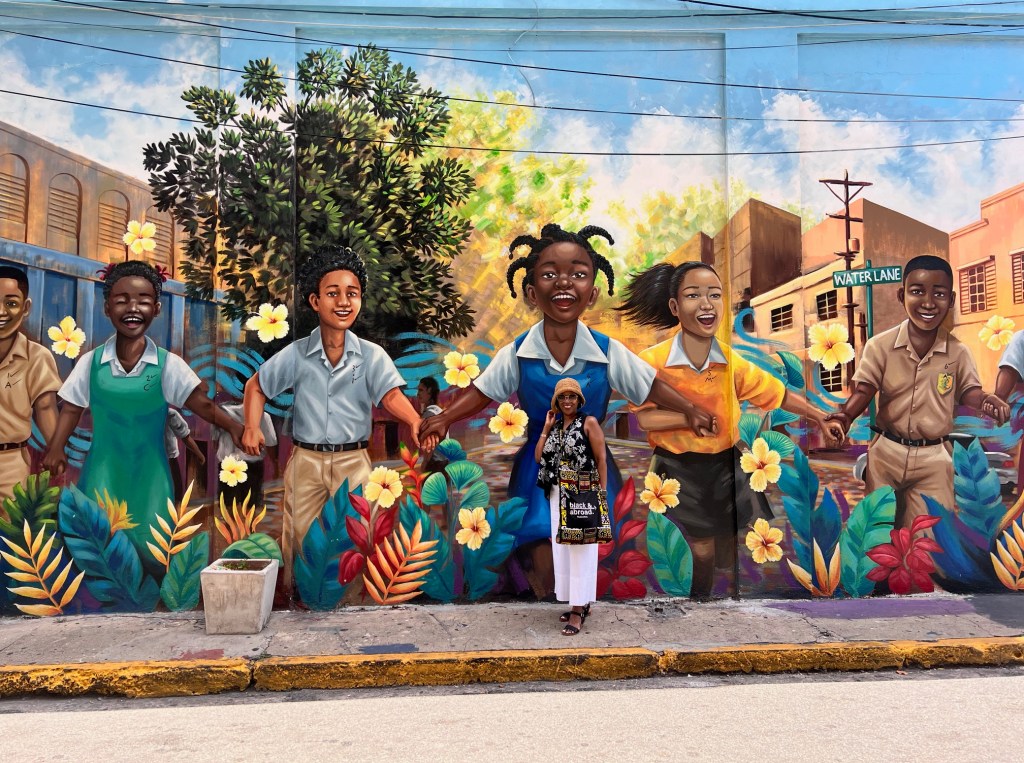
Surrounded by the spirit of youth and resilience—Water Lane Mural in downtown Kingston, celebrating the beauty and promise of Jamaica’s next generation.

Earlier this month, I traveled to Jamaica for my Grand Aunt Alva’s homegoing service. She lived to be 106 years old—a life filled with wisdom, love, and quiet strength. Her passing brought our family together in Mandeville, where we gathered to celebrate her remarkable life. While it was a solemn occasion, it was also a homecoming of sorts—an opportunity to walk the paths of my family’s past and reflect on the legacies that shaped who I am.

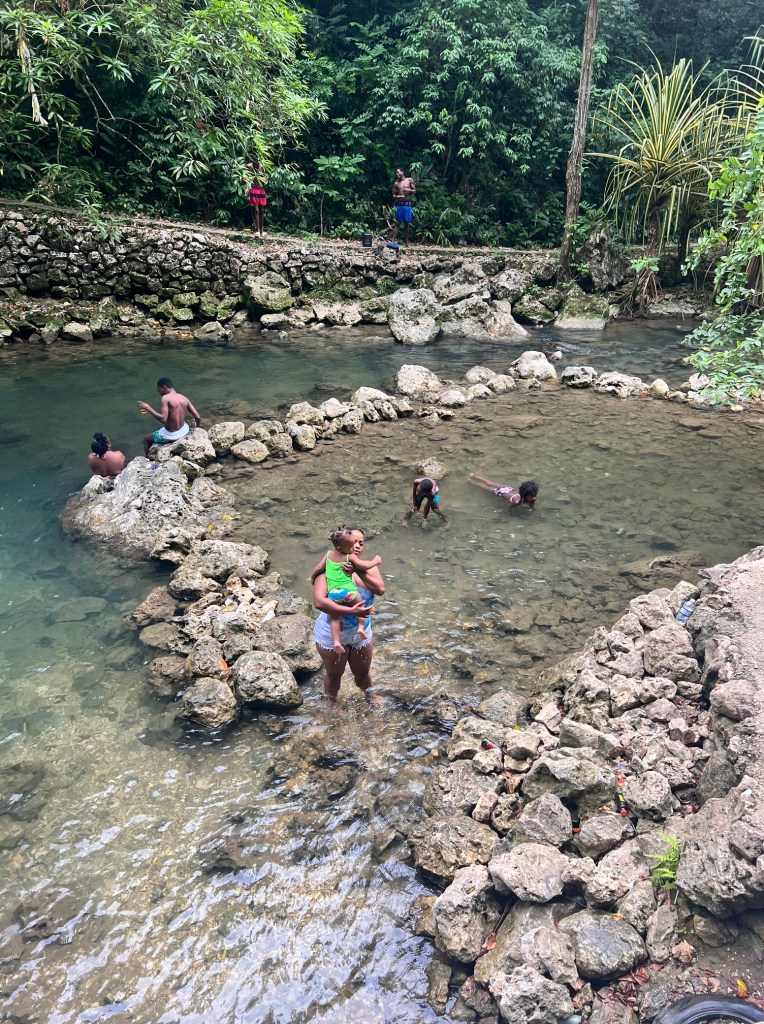
While in Jamaica, we spent a meaningful day in Oxford, Manchester—a rural farming community about 60 miles from the capital city of Kingston—where my father grew up. It was there that we retraced his roots, visited his childhood school, and honored the legacy he left behind.

Always a treat to visit Noisy River – Oxford, Manchester, JA – where the water sings and the vibes are unforgettable

One of the most meaningful stops was Comfort Hall All-Age School, where my father began his educational journey. As a boy, he would sit under the mango tree with his books, determined to make something of himself. One of the elders in the community, who knew him as a child, recalled, “He was different. Always studying. You could just tell he would go far.”

And he did.

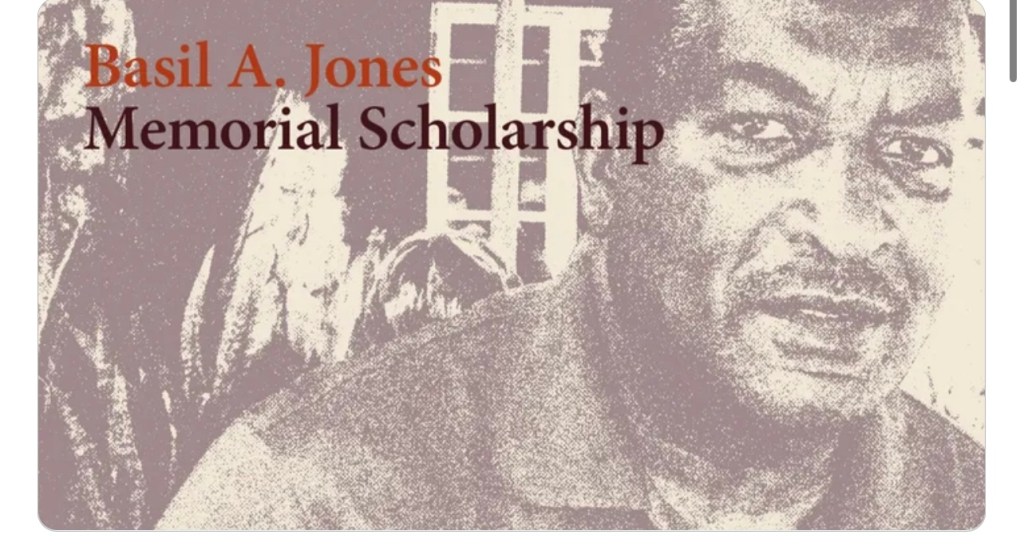
My father would go on to complete his education in Kingston and graduate from the University of the West Indies, Mona, but he never forgot where it started. He often spoke of Comfort Hall with fondness and gratitude, and over the years, he supported the school through donations and supplies. After his passing in 2024, my brother established the Basil A. Jones Memorial Scholarship in his honor—because what better way to honor his memory than to invest in the future of the very place that shaped him.

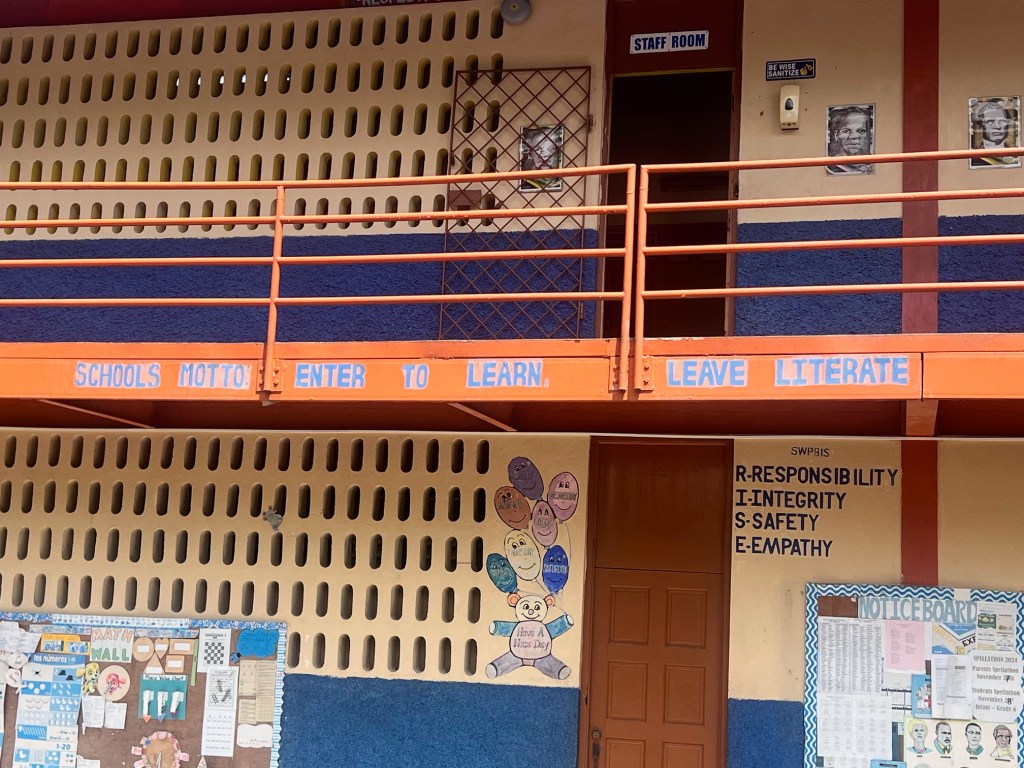
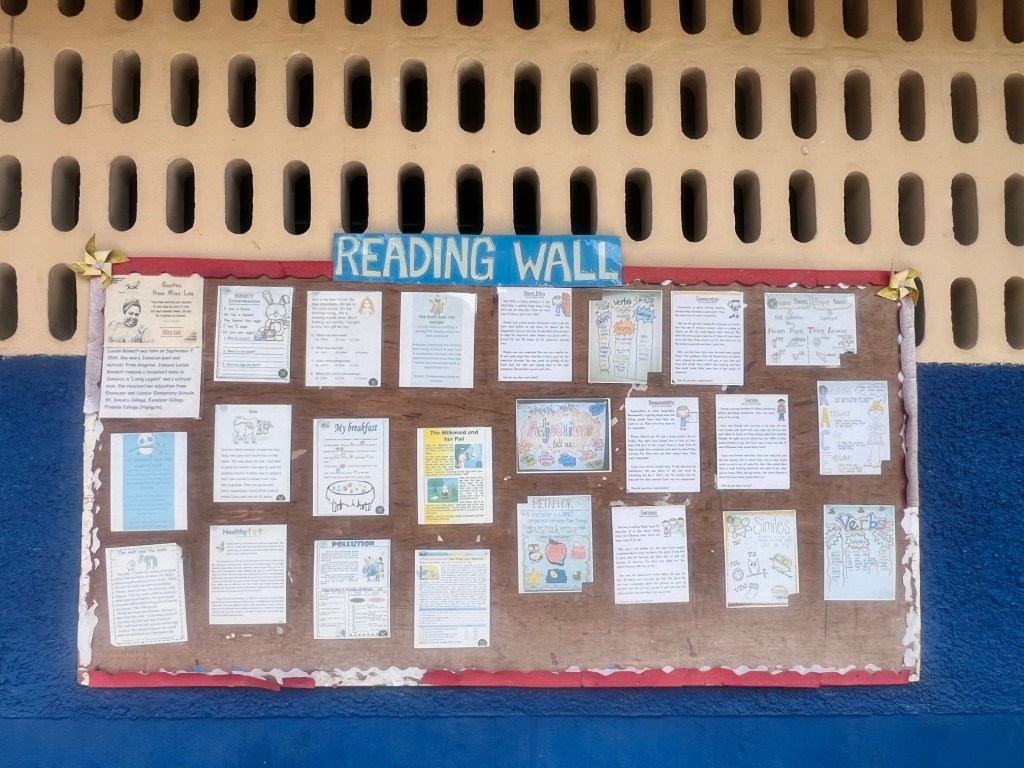
While visiting the school, I was moved by their commitment to literacy. A large Reading Wall, proudly displayed on campus, showcases student work and learning activities that reflect their joy in reading and writing. Just above it, the school’s motto is painted across the upper balcony:

ENTER TO LEARN — LEAVE LITERATE

“Enter to Learn, Leave Literate” — a powerful reminder of what’s possible when education is rooted in purpose and community. Comfort Hall All-Age School, Oxford, Jamaica.

I stood in front of it, struck by how deeply it aligned with the work we do at Tanzania Development Support (TDS)—where literacy, particularly for girls in rural communities, is at the heart of our mission. In both Comfort Hall and Tanzania, literacy is not just an educational benchmark. It’s a pathway to equity, independence, and hope.

A wall that speaks volumes—showcasing student voices, creativity, and a love of reading at Comfort Hall All-Age School in rural Jamaica.
My brother and I with the current Principal of Comfort Hall Primary School – Ms. Nicholson, thanking her for her dedication and commitment to young people and education, and her support in administering our father’s scholarship to deserving students

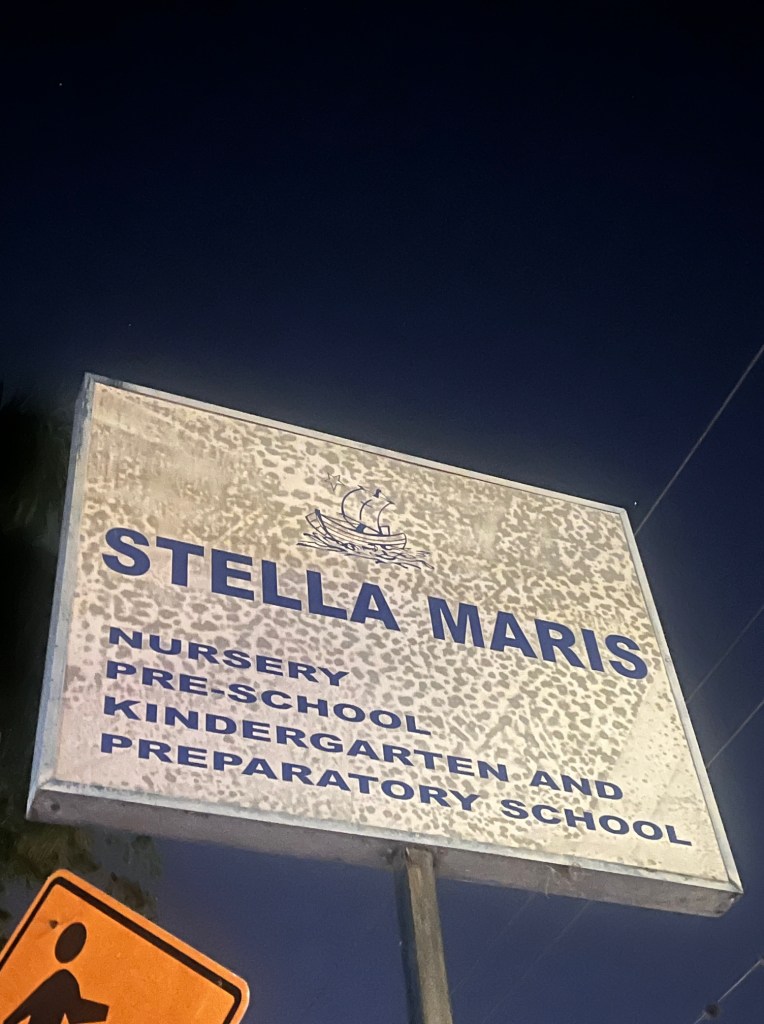
The journey didn’t end in Manchester. I later traveled to Kingston, where I visited my childhood school, Stella Maris Preparatory. While I didn’t get a chance to explore the grounds in full, just standing outside the gates brought back memories of school uniforms, morning assemblies, and the early seeds of curiosity that would shape my future.

A glimpse of my early beginnings—Stella Maris Preparatory School in Kingston, where my love for learning first took root.

This trip reminded me that education is more than a formal experience—it’s a deeply personal, cultural, and community-driven force. It shows up in the aunties who model lifelong learning. In the children proudly pointing to their work on a reading wall. In the mango trees that shaded my father’s dreams, and in every initiative I support that centers literacy, empowerment, and opportunity.

These places—and the people who shaped them—remind me why I do what I do.

About Renée
Renée Jones is the Founder and Principal Consultant at Red Hills Consulting Group, where she leads strategic, operational, and transformational initiatives for Fortune 500 companies, nonprofits, and mission-driven organizations. With more than 20 years of experience leading complex initiatives, Renée helps organizations turn bold ideas into lasting impact. Outside of work, she mentors emerging leaders and champions social-impact innovation. https://redhillsconsultinggroup.com

Transformation Isn’t a Department—It’s a Culture Shift

In today’s disruption-prone world, the word transformation is everywhere. Organizations stand up “Transformation Offices,” appoint Chief Transformation Officers, and launch sweeping change initiatives backed by sleek dashboards and hefty budgets.

But if there’s one thing I’ve learned after leading complex transformation programs across Fortune 500s, nonprofits, and private equity-backed companies, it’s this:

Transformation isn’t a department. It’s a culture shift.


Beyond the Org Chart

Years ago, I supported a global beauty brand in a multi-year transformation initiative. We had the structure in place—program leads, governance teams, and detailed roadmaps. On paper, it looked like a textbook rollout.

But we quickly realized the deeper challenge: the culture hadn’t caught up to the vision.

Employees were still clinging to outdated ways of working. Middle managers quietly resisted new roles. Cross-functional collaboration was more talk than action. The transformation looked good on the org chart—but in the day-to-day rhythm of the business, it had not taken root.

That experience (and many since) cemented this truth: if you don’t shift the culture, you’re just reshuffling boxes.


Mindset Over Mechanics

Too often, transformation efforts lean heavily on the mechanical side—new technologies, reorganized teams, redesigned workflows. These are necessary, but not sufficient.

What’s harder—but far more impactful—is shifting how people think, behave, and engage.

When I worked with a major life sciences client to redesign their global PMO, our biggest wins didn’t come from the processes we implemented—but from the mindset we nurtured. We created safe space for functional leads to challenge old assumptions, encouraged transparency in reporting, and celebrated progress—even when it was messy. Over time, the PMO became not just a compliance engine, but a trusted partner in strategic execution.


What Transformation Really Requires

Here’s what I’ve seen work across sectors:

🔹 Start with Purpose
I always begin with the “why.” When teams understand how the change aligns with their values or mission, resistance melts. At one nonprofit client, we framed a difficult org redesign around impact—what it would allow them to achieve for their beneficiaries. That alignment changed everything.

🔹 Model the Change
Transformation takes hold when leaders walk the talk. In my work leading enterprise-wide change, I’ve partnered with executive teams to shift from command-and-control dynamics toward more collaborative, inquiry-driven leadership—where listening, humility, and curiosity drive better outcomes. Culture change always starts at the top.

🔹 Create Psychological Safety
In a recent diagnostic for a multinational client, we uncovered that fear of failure was silently killing innovation. We worked to reframe “failure” as learning—introducing pilots, retrospectives, and peer coaching. When people feel safe, they grow.


A Living, Breathing Shift

Transformation isn’t something you launch and leave behind. It’s a living process—rooted in behaviors, sustained by belief systems, and reflected in how your people show up every day.

So if you’re leading change—ask yourself: are you designing systems, or shifting culture?

Because long after the project plans are archived, culture is what carries the transformation forward.


About Renée
Renée Jones is the Founder and Principal Consultant at Red Hills Consulting Group, where she leads strategic, operational, and transformational initiatives for Fortune 500 companies, nonprofits, and mission-driven organizations. With a focus on clarity, collaboration, and measurable impact, she helps organizations turn bold vision into real-world results. www.redhillsconsultinggroup.com

How I Help Organizations Move from Vision to Value

A behind-the-scenes look at my consulting approach—and why it works.

When organizations bring me in, they’re often standing at the edge of something big: a new strategic plan, a transformation initiative, or a change they know is necessary—but haven’t quite figured out how to execute.

They don’t need more theory.
They need a trusted partner who can bring structure to the chaos, ask the hard questions, and guide teams from talk to traction.

That’s what I do at Red Hills Consulting Group.

Whether it’s a nonprofit trying to scale impact, a PE-backed company improving operational efficiency, or a corporate team realigning after reorg—I help organizations move from vision to value. Here’s how.


🧭 1. Clarify the Vision

Every engagement starts with understanding your “why.”
What does success look like in 12 months? What challenges are in your blind spots? What are we solving for—and for whom?

I help leadership teams align around shared goals and surface the hidden friction points. This clarity becomes our North Star for everything that follows.


🔍 2. Diagnose the Gaps

This is the step most organizations skip—and the one that changes everything.

I bring a diagnostic mindset to every engagement. That might look like interviewing key stakeholders, auditing business processes, or assessing current-state tools and performance indicators. The goal: get a fact-based picture of what’s working, what’s not, and where we need to focus.

When I led a margin optimization project for an advisory firm, for example, it wasn’t just about cost savings—it was about understanding how work was prioritized, where teams were stuck, and how decisions were made.


🗺️ 3. Co-Design the Path Forward

I don’t drop in with a generic playbook.

Instead, I co-create solutions with your internal teams—whether we’re building a project governance framework, standing up a Strategic PMO, or designing an operational roadmap. That shared ownership ensures the plan isn’t just right—it’s real, and it sticks.


⚙️ 4. Activate with Precision

Ideas are only as strong as the systems behind them.

I bring disciplined execution to the table:

  • PMO tools and dashboards to manage progress
  • Clear roles, responsibilities, and routines
  • Change management to engage teams and manage resistance

Whether I’m guiding a global brand through a product portfolio transformation or advising a nonprofit board on strategic direction, execution is where we turn insights into momentum.


📈 5. Measure What Matters

From efficiency gains and ROI to board alignment and stakeholder trust—we define what success looks like early and track it consistently.

I work with clients to identify the metrics that matter most to their mission, their investors, and their teams—and we build a feedback loop to sustain progress.


From Strategy to Impact: What You Can Expect

Across every sector I serve—nonprofit, healthcare, education, consumer goods—clients come to me for structure, clarity, and results.
They stay because I deliver.

I don’t just help you build the plan.
I help you deliver it—with confidence, integrity, and measurable impact.


Let’s Move Your Vision Forward

If you’re at an inflection point and ready to turn strategic vision into reality, Red Hills Consulting Group is here to help.

📩 Let’s talk: Contact Us
🔗 Or explore our work: Services

About Renée
Renée Jones is the Founder and Principal Consultant at Red Hills Consulting Group, where she leads strategic, operational, and transformational initiatives for Fortune 500 companies, nonprofits, and mission-driven organizations. With more than 20 years of experience leading complex initiatives, Renée helps organizations turn bold ideas into lasting impact. Outside of work, she mentors emerging leaders and champions social-impact innovation. https://redhillsconsultinggroup.com
Why Literacy Matters: The First Step Toward Lifelong Learning

By Renée Jones | Board Member, Tanzania Development Support

This article was authored by Renée Jones, in her role as a Board Member of Tanzania Development Support (TDS). Red Hills Consulting Group is proud to support education equity and community-driven development.

In communities around the world, the ability to read and write is often taken for granted. Yet for many children in rural Tanzania—and in countless underserved regions globally—literacy is not a given. It is a life-altering milestone: the first step on the path to lifelong learning, economic empowerment, and social mobility.

Literacy Is the Gateway

Literacy is the first academic skill children must master, but its importance goes far beyond the classroom. A literate child becomes a confident learner. A literate girl is better equipped to understand her rights, navigate systems, and make informed decisions. A literate parent is more likely to support their child’s education, prioritize healthcare, and build economic stability for their family.

In essence: literacy unlocks everything.

In rural Tanzania, education can be a lifeline—but for most children, especially girls, it’s a path filled with barriers. Literacy is the first and most fundamental step on that path. Without the ability to read, students are locked out of every future opportunity—academic success, career mobility, civic participation, and more.

That’s why Tanzania Development Support (TDS) has made literacy a cornerstone of our work in the Mara region. From early reading programs to community-led Reading Circles, we are investing in the power of books to open minds and change lives.

“Reading is the fundamental tool of learning in the 21st century… whether it’s a book, a street sign, a grocery label, or a screen on the internet. Effective reading is the key to learning and understanding the world around us.”

📚 A “Center for Learning” in Rural Tanzania

The Madaraka Nyerere Library and Community Resource Center (LCRC) stands as a beacon of knowledge for the villages in the Musoma Rural area. Envisioned by community leaders as a kituo cha maarifa (“center for learning”), the LCRC houses one of the largest collections of books by African authors in Swahili in any community library in the country.

Since its construction in 2016, the LCRC has evolved into a hub for educational innovation. In 2019, we expanded its infrastructure with internet connectivity and open-source digital library tools, enabling access to global learning even in areas without power.

Yet the heart of this work is not the technology—it’s the people and programs.


📖 Reading Circles: Building a Culture of Literacy

Launched in April 2025, Reading Circles are one of the LCRC’s most vibrant literacy efforts. These community-led sessions bring students, teachers, and volunteers together to read aloud, ask questions, and share stories.

Each week, children gather across Musoma Rural—under mango trees and in classrooms—to experience the joy of books.

“Just seeing these photos made my heart sing. I truly believe this experience is going to change students’ lives and transform education in this part of the world!”
Dr. Andrea Trudeau, TDS Board Member

Thanks to Andrea’s leadership and a generous $2,000 fundraising effort, hundreds of children now benefit from this program. Special thanks to Joyce, Moses, and Fr. Otieno, who are leading efforts on the ground.

“Creating a reading culture in Musoma Rural schools and villages will pay dividends for generations to come.”


👶 Early Literacy: Laying the Foundation

Alongside Reading Circles, the LCRC runs two early reading programs that collectively reach over 100 children annually:

  • Pre-Primary Reading Program (ages 3–5): A half-day experience introducing numbers, letters, and storytelling.
  • Early Reading Program: In partnership with Nyegina Primary School, this supports children who need additional help with reading.

Together, these programs build skills, spark curiosity, and nurture confidence.


💡 Literacy Is Power

In a world where access to information defines opportunity, literacy is not a luxury—it’s a necessity. For the students of Musoma Rural, it’s the bridge to a future where they can lead, contribute, and thrive.

At TDS, we believe literacy transforms lives. And we thank every teacher, volunteer, donor, and advocate helping us turn this belief into action.


✨ How You Can Support

  • 📚 Sponsor books or literacy materials
  • 💻 Volunteer to support our education initiatives
  • 🙋🏽‍♀️ Become a recurring donor
  • 📢 Share this story and raise awareness

Learn more at www.tdsnfp.org or email us at info@tdsnfp.org.

About Renée
Renée Jones is the Founder and Principal Consultant at Red Hills Consulting Group, where she leads strategic, operational, and transformational initiatives for Fortune 500 companies, nonprofits, and mission-driven organizations. With more than 20 years of experience leading complex initiatives, Renée helps organizations turn bold ideas into lasting impact. Outside of work, she mentors emerging leaders and champions social-impact innovation. https://redhillsconsultinggroup.com
When Girls Learn, Communities Rise

May 28, 2025

Written by Renée Jones, TDS Board Member

In rural Tanzania, education can be a lifeline—but for most girls, it’s a path strewn with obstacles. In the Mara region, a large percentage of girls do not complete secondary school, despite strong evidence that education leads to better health, economic stability, and brighter futures for entire communities.

At Tanzania Development Support (TDS), we believe that every girl deserves the chance to stay in school and thrive. Through our work in the region—especially via the Rose and Karl Willmann Scholarship Fund—we’ve seen firsthand how much potential lies within these young women, and how much is at stake if they’re forced to drop out.

This is more than an education crisis. It’s a matter of equity, opportunity, and generational transformation.

Poverty: When Education Is a Luxury

Even in public schools, education is not free. Uniforms, books, meals, sanitary supplies, and boarding fees add up quickly. For families already struggling to make ends meet, the choice is often between feeding the family and sending a daughter to school. In many cases, boys are prioritized for education while girls are expected to help at home or generate income. Education becomes a luxury—not a right.

TDS works to change that narrative. Through the Willmann Scholarship Fund, we remove these financial barriers. The scholarship covers everything a student needs—from tuition and uniforms to housing and meals—so that she can focus on learning and thriving.

As one student wrote:

“My good academic performance has been influenced by the presence of good environment for studying and peace of staying in school without returned home to take the school fees.”

By becoming a contributor to the Willmann Scholarship Fund, you are helping change the future for dozens of gifted girls in the Mara. A full scholarship is $900 annually and covers all the expenses for a girl to attend Nyegina Secondary School. A monthly donation of $75 is an affordable way to sponsor a girl. Consider changing the life of a girl and her future family by becoming a sponsor today.

The road between Nyegina and Mkirira is about 12km across rolling hills. Until the recent completion of a new public secondary school in Nyegina, students would make the walk twice a day to attend secondary school in Mkirira.

Distance: When the Journey to School Is Too Far

In rural areas, many girls walk 5 to 10 kilometers each way to reach school. These long, exhausting commutes—often before sunrise and on empty stomachs—are physically dangerous and emotionally draining. Safety is a serious concern. Parents may pull girls out of school to protect them, especially as they approach adolescence.

That’s why TDS has supported the construction of a dormitory, allowing 160 girls to live where they learn at Nyegina Secondary School. This drastically reduces their risk, fatigue, and dropout rates, creating a more supportive learning environment.

As one scholarship recipient shared:

“I have peace because I am not walking many miles every day to go to school. I am in boarding and I have enough time to study and learn many things from teachers and my fellow students because we are coming from different tribes.”

Tradition: When Culture Clashes with Opportunity

Deeply rooted social norms often dictate that a girl’s primary role is to marry young, care for siblings, and support her household—not to pursue education. Girls are taught to stay quiet, stay close, and stay home.

But we know that when girls stay in school, they gain confidence, earn more over their lifetimes, delay early marriage, and make informed decisions about their health and future.

Through programs like Reading Circles and 4H Career Pathways, TDS helps girls reimagine what’s possible. These spaces introduce them to new ideas, new skills, and new futures—beyond what tradition may have taught them.

“My dream is to be a nurse and my subjects I like is chemistry, Geography and Biology. I study hard in order to fulfill my dream. Apart from that I wish to be a big trader in Tanzania and outside of Tanzania also to support and help People with basic needs like poor girls, disabled, and other groups as the way you, did to me am continue to thank for your kindness. Now I am writing this message by using computer of Madaraka Nyerere Resource Center and I am learning computer studies.”

“Through your support you have created a good bridge for my future.”

The Ripple Effect of Education

The challenges are real—but so is the potential. When one girl is educated, her whole community benefits. She becomes an advocate, a wage-earner, a mentor, a mother who insists her children—daughters and sons—go to school.

I think often of the girls in the Willmann Scholarship Program, many of whom write us to share their goals of becoming teachers, doctors, engineers, or community leaders. They are determined. They are bright. They are ready. We just need to help them stay the course.

As several girls have said:

“Through this chance you gave me, it enabled me to study at good environment where there are all resources and I wish through this I will get great success in my form four national exams.”

“Also I am the only one who has got this secondary education in my family. So, after getting this opportunity my family was very happy and they know that one day I will be a good and a great person in my life.”

“It’s a very big sacrifice that you’ve made because paying such a lot of money for someone that you don’t know and you never meet needs a person with heart of helping. If could not be you I could not be here I am. I’ve studied from form one up to form four without being returned at home for failing to pay school fee. THANK YOU VERY MUCH.”

As a sponsor, I’ve experienced firsthand how rewarding it is to support a Willmann Scholar. I’ve had the privilege of sponsoring a bright and determined student in secondary school. Reading her letters, learning about her goals, and seeing her progress has been deeply moving. I hope to meet her one day soon and witness the impact of this opportunity in her life. 

Here’s How You Can Help

  • Sponsor a Willmann Scholar and provide full support for her education journey
  • Share this story to raise awareness of the barriers—and the breakthroughs
  • Donate to our programs to expand access and impact across the region 

Because when girls learn, communities rise. And when we invest in their futures, we’re investing in our shared humanity. Let’s remove the barriers. Let’s open the doors. Let’s walk beside these girls as they pursue the futures they deserve.

Click Here to Support a Scholarship

About Renée
Renée Jones is the Founder and Principal Consultant at Red Hills Consulting Group, where she leads strategic, operational, and transformational initiatives for Fortune 500 companies, nonprofits, and mission-driven organizations. With more than 20 years of experience leading complex initiatives, Renée helps organizations turn bold ideas into lasting impact. Outside of work, she mentors emerging leaders and champions social-impact innovation. https://redhillsconsultinggroup.com