

The Bridge
Strategy → Execution
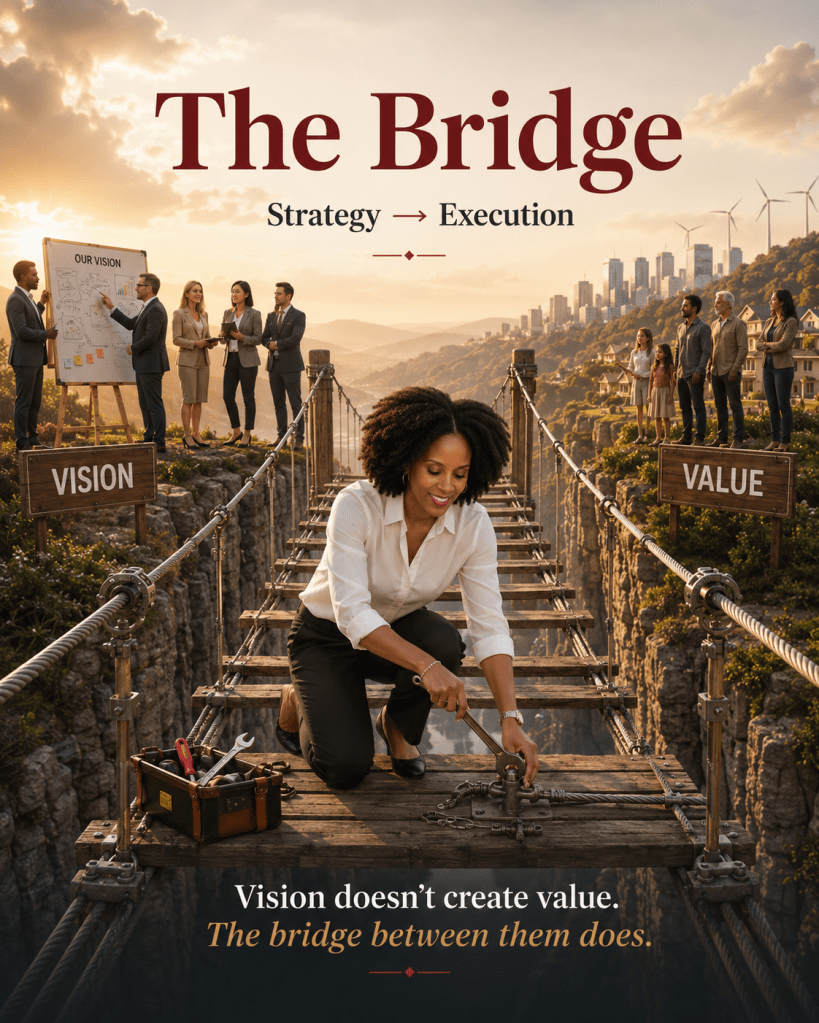
Vision does not create value. The bridge between them does.
Organizations invest significant time and energy developing strategy.
Leadership teams align around priorities.
Goals are defined.
Plans are approved.
Kickoff meetings create momentum.
Then the work begins.
A few months later, progress often starts to slow.
Not because people stopped believing in the strategy.
Not because the vision lacked ambition.
And not necessarily because employees are resisting change.
The strategy stalled because the organization did not intentionally build the bridge required to carry it into everyday execution.
That bridge is not made of enthusiasm.
It is built through the systems that shape how work moves:
Clear decision rights.
Governance that keeps priorities aligned.
Operating models that connect teams and responsibilities.
Capacity that is designed rather than assumed.
Accountability embedded in the organization instead of dependent on heroic individuals.
Strategy becomes real through the decisions people make every day.
Most employees do not need to memorize the strategic plan.
They need to understand what the strategy means for their role, what trade-offs it requires, and how it should influence the decisions they make when leaders are not in the room.
That is where many strategies lose force.
The destination may be clear, but the route is not.
Teams understand the aspiration but lack the authority, principles, resources, or coordination needed to act consistently.
The result is predictable:
Priorities compete.
Decisions climb unnecessarily back to senior leaders.
Teams interpret the strategy differently.
Capacity becomes overloaded.
Execution fragments across functions.
The bridge begins to crack one decision at a time.
A strong bridge also carries traffic in both directions.
Execution should not simply receive instructions from strategy.
It should return evidence.
The earliest months of implementation reveal where assumptions met reality, what customers or communities actually experienced, and where the operating environment changed.
Those lessons only become organizational learning when they influence decisions and create visible amendments to the strategy, operating model, or execution plan.
Feedback that is collected but never acted upon is not learning.
It is freight left at the far end of the bridge.
The strongest organizations create both an outbound lane and a return lane.
They translate strategic intent into everyday action.
Then they bring evidence from execution back into leadership decisions.
That is how strategy stays relevant without losing direction.
The distance between vision and value is rarely measured in ambition.
It is measured in execution.
Key Takeaways
- Strategy creates direction, but execution creates value.
- The bridge between them is built through governance, decision architecture, capacity, accountability, and operating discipline.
- Employees need clarity about how strategy should influence their everyday decisions.
- Decision rights and guiding principles allow teams to make trade-offs without unnecessary escalation.
- Execution must create a return lane so evidence from the work can refine strategy.
- Feedback becomes learning only when it results in documented decisions or visible changes.
Leadership Reflection
A strategy is only as strong as the decisions it influences.
Ask yourself:
- If you stopped ten people across your organization today, would they describe the strategy in the same way?
- Would they make the same trade-offs when priorities compete?
- Do they have the authority and clarity to act without waiting for leadership?
- Where does momentum consistently slow down?
The answers often reveal whether your bridge is carrying the work—or quietly beginning to crack.
Related Red Hills Work
Red Hills Consulting Group helps organizations strengthen the bridge between strategy and execution through:
- Strategy architecture
- Governance and decision architecture
- Operating model design
- Portfolio and capacity alignment
- Implementation planning
- The Red Hills Action Lab™
Ready to Strengthen the Bridge?
Your strategy may already be the right one.
The question is whether your organization has the governance, decision-making discipline, and operating model to carry it into everyday execution.
← Volume 1: The Foundation: The Foundation
Continue the Series: The Orchestra — Decision-Making in Harmony →Volume 3: The Orchestra
 Red Hills - From vision to value