

A board member reached out to me recently with a question I do not hear often enough.
Her organization was not in crisis. The executive director was not leaving. But she wanted to think seriously about succession — not as a contingency plan, but as a structural strategy. What would it take, she asked, for this organization to absorb a leadership transition without losing momentum?
It was one of the most honest governance conversations I have had in a while.
Because most organizations do not ask that question until they have to. And by then, the cost of not having answered it is already showing up.
What Leadership Transition Actually Tests
Every week I see announcements on LinkedIn. A new CEO joining a foundation. An executive director stepping down after a decade. An interim leader named while a search is underway.
These are normal organizational moments. But they are also stress tests.
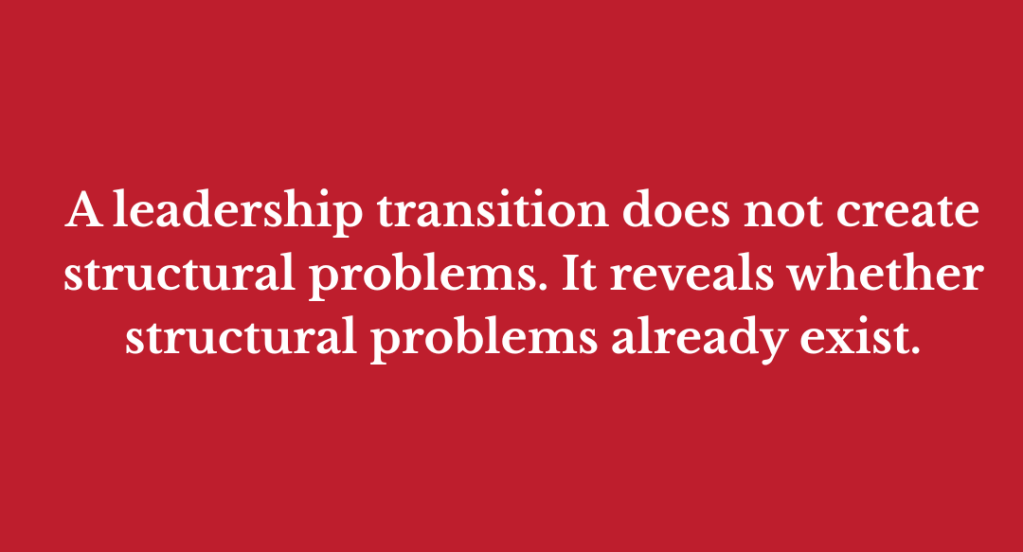
A leadership transition does not create structural problems. It reveals whether structural problems already exist.
The organizations that navigate transitions well are not the ones with the smoothest handoffs or the most detailed succession binders. They are the ones where the execution infrastructure — governance clarity, decision rights, operating models, accountability structures — was built to hold regardless of who is in the seat.
The ones that struggle are the ones where too much lived in the leader.
Three Scenarios I See Play Out
The Outgoing Leader
Maria had led her nonprofit for eleven years. Under her leadership the organization grew from a $3M community program to a $9M regional institution. She knew every funder personally. She held every key relationship. She made most of the significant decisions, not because she was controlling, but because the organization had never needed to formalize what she already knew.
When she announced her retirement, the board celebrated her legacy and began a search. What they did not do was ask the harder question: what exists on paper, in systems, and in defined roles that will still be true when she is gone?
Six months into the transition, three major funders had not renewed. Two senior staff had left. The incoming leader was making decisions without context that had never been documented.
The problem was not Maria’s departure. The problem was that Maria had become the infrastructure.
The Incoming Leader
David was named CEO of a $7M foundation after a national search. He came with strong credentials, a clear mandate for growth, and genuine enthusiasm for the mission.
What he walked into was a governance structure that had never been formally defined, a senior team with overlapping accountabilities, and a board that had operated as an advisory group rather than a governing one for years.
Within ninety days he was frustrated. Decisions were slow. Accountability was unclear. He could not tell who owned what.
He was not failing. He was navigating an infrastructure that was never built for the complexity the organization had already reached.
The search process had found the right leader. Nobody had asked whether the organization was structurally ready to receive one.
The Organization in Transition
The Hargrove Institute had just completed a successful capital campaign. They were growing. The founding executive director had transitioned out eighteen months earlier and the new leader was twelve months in.
On paper things looked fine. In practice, the senior team was operating with three different understandings of the strategic priorities. The board had approved a new initiative without a clear owner or operating budget. And the new ED was spending more time managing internal confusion than driving the work forward.
This was not a leadership failure. It was a structural one. The transition had changed the person at the top without redesigning the systems underneath.
What the Board Member Got Right
The board member I spoke with was not asking about succession planning in the traditional sense — who would replace the ED, what the timeline would look like, how to run the search.
She was asking a structural question: is this organization built to hold its own weight through a transition?
That is a different question. And it is the right one.
The answer almost always requires examining the same foundations the Red Hills Action Lab™ is designed to surface. Who owns the critical decisions when the leader is not in the room? What exists in the operating model that does not depend on any single person’s relationships or institutional memory? Where does accountability live in a way that survives a change at the top?
These are not succession planning questions. They are execution infrastructure questions. And the best time to answer them is not during a transition.
It is long before one becomes necessary.
The Question Worth Asking Now
If your executive director or CEO stepped back tomorrow, what would hold and what would fracture?
Not the mission. Not the relationships. The structure.
If that question creates any hesitation, that hesitation is the beginning of the real work.
Scenarios depicted are illustrative composites, not specific client engagements.
About Renée
Renée Jones is the Founder and CEO of Red Hills Consulting Group, a boutique management consulting firm specializing in strategy, execution, and organizational transformation.
With more than two decades of experience advising Fortune 500 companies, nonprofits, and mission-driven organizations, Renée works with leadership teams navigating growth, transition, and increasing complexity. Her focus is on building the structure behind the strategy. That means clarifying governance and decision rights, defining operating models that can scale, and developing the execution discipline required to move from vision to sustained impact.
She is the creator of the Red Hills Action Lab™, a structured diagnostic experience that helps leadership teams pressure-test execution readiness before problems become visible.
Renée believes the most sophisticated strategies are not the most complex. They are the most causally clear. And the difference between something that launches and something that lasts is almost always structural.
Red Hills Consulting Group exists to close that gap.
 Red Hills - From vision to value